Showing posts sorted by relevance for query microbee. Sort by date Show all posts

Saturday, July 15, 2006

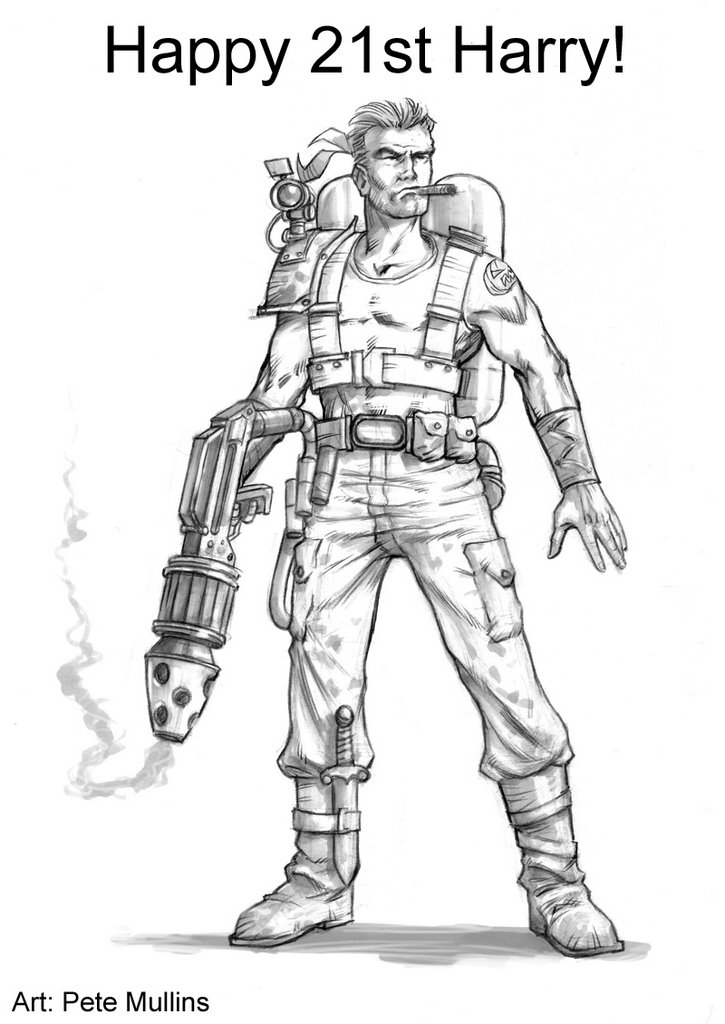
Halloween Harry's 21st Anniversary


It's hard to believe it, but Halloween Harry turned 21 this year!

When I made the first Halloween Harry game all those years ago I had no idea that I'd be still making video games 21 years later. But here I am, so I figured I'd give you a little insight into the creation of the first game and follow up with some more entries on the other games later.

Most people remember the PC version of Harry released by Apogee back in 1993 but the very first game was made on the Microbee computer in 1985. The Microbee was probably the only Australian made computer system - sort of like a Commodore 64 but with a Z80 processor and no color. Still, the Microbee was sold to local schools and was a popular educational and home computer both in Australia and Sweden.

I wrote my first game called Chilly Willy (a Pengo clone) in 1984 during my high school Christmas vacation. I sent the finished game off to Honeysoft, the software arm of Microbee and they accepted it for publication. I was so happy that I sold a game that during my next Christmas vacation I set out to create a completely original game.

Inspired by Ghostbusters, the game was set in the 21st century and featured Harry, a Ghost Hunter, facing off against all sorts of evil across 13 levels. Essentially it was a platform shooter with some puzzle solving elements - set on a single screen. But rather than explain the back story, why not read the actual in game instructions that appeared on the start screen:

It is the 21st century and from this futuristic new world comes an exciting new hero:- HALLOWEEN HARRY!

As Halloween Harry, a fearless ghost-hunter, you have been assigned to destroy an evil witch that has taken over a 13 room building. You do this by collecting the magic item in each room, then escape through a mystical door.

There are 12 items to collect, ranging from a broom in room 1 to a cauldron in room 12. When all the items are collected you must confront the witch in the 13th room. The witch is protected by a magical barrier, so you must collect a padlock and a key (in any order) so that her defence is broken down...

Once exposed you may zap the witch with your trusty garlic-blaster laser gun, (which has 13 shots). 3 additional shots may be obtained by grabbing the bonus garlic. To make your task difficult, the witch has summoned up various ghosts and ghouls, as well as the dreaded dropjaws and zombie hands to destroy you!

Don't forget there's a time limit. It can be extended by the magic hourglass that appears when time is low.

Notice how I explained everything up front, even the ending of the game. Mystery and self-discovery wasn't something I had learnt in school at that point.
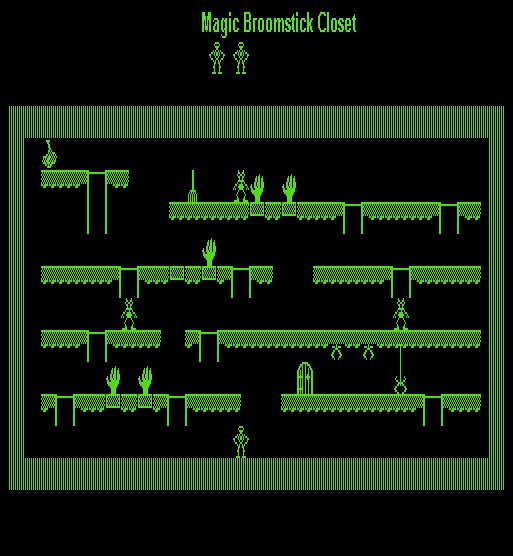

Each level had a different name, which was related to the special item you'd find in that room - and here they are:
  1. Magic Broomstick Closet
  2. Witches' Hat Room
  3. The Enchanted Chalice
  4. Pumpkin-Pie Room
  5. The Wizard's Library
  6. The Magic-Potion Pantry
  7. The Room of Wax
  8. Black Cat's Cavern
  9. The Crystal Ballroom
  10. Grandfather's Clockroom
  11. Yoric's Bedroom
  12. The Witch's Cauldron Room
  13. The Bewitching Hour
I initially drew the graphics on paper to get an overall look and feel. Then I used a tool called PCG Edit that allowed me to turn on and off pixels on screen so I could see the sprites as they would appear in game. I'd save the pixel data and include it in the game code.

I also used a simple sound editor to make really crude white noise effects that I used for monster and weapon sounds.

All up I spent around six weeks on Halloween Harry before I thought it was ready to ship. I saved the game to tape and sent it off to Honeysoft who happily signed it up. Then I spent the rest of the holidays hanging out with my friends doing regular kid stuff like swimming in the local river, riding my bike and exploring the local bush.

I had a ball making the game - spending late nights as a computer nerd cutting code while my parents shook their heads wondering what on Earth it was that I was doing. Even though I sold a game the year before I don't think they really quite "got it".

Making games was such an otherworldy concept back then that I didn't even talk about it amongst my school mates. How times have changed!

Anyway, I'm proud to have created something that has lasted the test of time and is circulating around the interweb in some form or other. Happy 21st birthday Harry.

Saturday, May 21, 2016

Learning To Be A Better Programmer

I have a confession to make. Despite being a game developer and having programmed lots of games, I've always considered myself a game designer rather than a game programmer.

The truth is there have always been way better programmers than me in the business. People who can squeeze every little bit out of a game engine or who can write faster, more elegant code. As a result I've always shied away from personally programming fast action games.

I made the original Halloween Harry on the Microbee in BASIC in the mid eighties. Writing it in assembly was beyond me so I designed the game around the limitations of BASIC and it ran fine.
Halloween Harry for the Microbee (1985)
In the early nineties I did the original prototype for the reboot of Halloween Harry in AMOS on the Amiga. It ran okay, but wasn't shaping up to be a game that could take on the world.

Thankfully the talented Rob Crane and Tony Ball took over the coding of the game engine and graphic engine respectively and made fast, slick code that brought Halloween Harry to life and landed us a deal with Apogee. I focused on design and level building for the remainder of the project!

When I did program, I chose games that didn't require high frame rates. Flight of the Amazon Queen was a leisurely adventure game that didn't rely on multiple levels of parallax scrolling or cutting edge particle systems. It was the sort of game that I felt comfortable building.
Flight of the Amazon Queen (1995)

I tended to focus on puzzles games too - Word Shake is an early example.
Word Shake (2005)
I followed this up with other puzzle/brain training games like Brainiversity, Smart Attack, Snappy Word, Stroop Attack and Brainiversity 2.

Even the more recent Save Our Village was designed to move at a leisurely pace, focusing on town building and exploration.
Save Our Village (2016)
But now, with great tools like Unity3D and XCode and languages like C# and Swift I have the opportunity to work with high level programming languages that also produce lightning fast code.

And  thanks to the internet and the many excellent programming resources like raywenderlich.com I am learning a lot more - and doing it faster and easier than ever before.

In fact, I now think of myself as a game designer AND game programmer.

I reckon I've earned that.

-Johnno

Thursday, May 24, 2007

Halloween Harry/Alien Carnage as Freeware!

In collaboration with 3DRealms we've released Halloween Harry/Alien Carnage as freeware today!


Halloween Harry, the tough as nails marine from Alien Carnage, is 22 years old this year. He was the star of a game I wrote on the Australian Microbee computer system and released commercially in 1985. I was still in high school at the time and was super excited to have sold my second computer game (the first was called "Chilly Willy", a clone of the classic arcade game, Pengo).


I left school, studied computer science at university, and then got a "real job" as a programmer at a telecommunications company. That lasted just over two years before the computer game bug bit again. Now I was developing for the Amiga computer and had started work on a re-make of the Halloween Harry game I made as a kid - the game that would eventually become Alien Carnage!

With the help of a local comic artist we cooked up a demo that had great graphics and the core of a cool game. Through sheer luck I then hooked up with two other programmers who were making PC games. They were "coding demon" Robert Crane, and "graphics wizard" Tony Ball. We joined forces and Robert took over as lead programmer while I took the reigns on design. In no time we had a very addictive game on our hands.


Then, through sheer luck, we hooked up with Scott Miller and George Broussard from Apogee and before we knew it, the hottest shareware publisher on Earth was publishing us. Back in 1993 when Alien Carnage was first released, we had the honor of being one of the best selling shareware games of the year - an honor that we held on to until a little old game called "Doom" was released a few months later!

I want to say a big thank you to the DOSBox Development Team and Joe Siegler for putting this all together. Nice work guys!

Thursday, May 31, 2007

More Harry Stuff

The Alien Carnage/Halloween Harry freeware release has been getting some buzz on the internet. It looks like a lot of people were fans of the original game when it was released back in 1993. Hopefully they're wearing rose colored glasses when they re-play the game :-)

I spoke about some of the potential Harry sequels a few days ago and since then I found this screen shot from the proposed Zombie Wars sequel (which would have technically been the 4th Harry game - after the Microbee version, Alien Carnage and Zombie Wars).


Basically this was a hires (SVGA) upgrade to the Harry series, but by this time 3D was taking a hold and that's when we diverged into the world of 3D games development. Sadly the project was shelved and Harry was put on ice.

As for the 3D projects - now that's a whole blog entry in of itself!

Friday, October 31, 2008

Happy Halloween Harry!

It's Halloween again!  I took my kids, Zac and Ella, trick or treating tonight.  Ella went as Snow White and Zac went as Bob the Builder.

We scored some booty from the neighbours before settling in to watch "It's the Great Pumpkin, Charlie Brown" on DVD.

And it wouldn't be Halloween if I didn't talk about the awesome game that is Halloween Harry.  The original game was created 23 years ago this year.  It's kind of weird having a computer game character that's older than some of the people in the games  industry!

Original Microbee version of Halloween Harry (1985)

If you want to find out more about Harry visit the Alien Carnage / Halloween Harry web shrine here.  

And if you want to download and play the PC version (it's now freeware), then check out Apogee's interview and download links here!

Happy Halloween!


Monday, March 26, 2018

14+ Years of Blogging

I was listening to the latest episode of The Talk Show podcast today and was fascinated to hear John Gruber and Jason Kottke talk about their history writing blogs which dated back into the late nineties.

It got me thinking about my experiences and history of blogging.

I went back to check out my first Blogger entry from 14 years ago and ironically it was me reminiscing about the good old days.

It seems fitting that I post that original entry again as I was very enthusiastic about how easy it was in 2004 to make games compared to 1984 :-)

So here is my first Blogger entry from Wednesday, 6th of October 2004.

I wonder how many readers are thinking back to 2004 (or even 2014) and remembering the first game they made?

-Johno

Twenty Years Ago - Oct 6th, 2004

I got a call from the Game Developers Association of Australia (http://www.gdaa.asn.au/) asking me about some of Krome’s major milestones. This was for a display on Australian games they are putting together and they wanted to know stuff like what year Krome was founded (1999 by myself, Steve Stamatiadis and Robert Walsh) and when TY the Tasmanian Tiger was released (2002). 
I asked them how far the Aussie games industry went back and was told the earliest entry they had was for Beam Software, which was founded in 1980.Suddenly, it dawned on me that I’ve been in the Aussie industry since pretty much the beginning. My first published game was called Chilly Willy and was released in 1984 on the Microbee system (http://www.thepcmuseum.com/appliedtechnology/) by a company called Honeysoft. Halloween Harry followed that up a year later. Then I took time out to study at University, where I wrote some more games. I didn’t release these commercially, but made a text adventure freely available on the university computer system. That was followed by a short stint as a programmer at a telecommunications company after graduation, and then I was straight back into it in 1991. 
Back then, the four years between when Beam began and when I was first published seemed like a lifetime, as most things do when you’re a kid. But looking back, I realize that I was there during the heady days of the Aussie industry. It’s weird, even though I’ve been making games for twenty years now it’s still as fresh and exciting as it was back then. 
But the great thing about making games today is that it’s a lot easier than it’s ever been! All you need is a PC (which most kids have access to) some development tools (like Blitz Basic and Pro Motion) and the burning desire to make a game. And the costs are so cheap that there’s no excuse. Blitz Basic costs USD $100, the same price as two Playstation2 games - get it online from http://www.blitzbasic.com/. 
I hope that in 2024 a whole bunch of kids will look back at 2004 and fondly remember their first game they wrote and distributed over the net. Wouldn’t that be cool? 
Well, that’s enough nostalgia for one day. Time to go make games!

Wednesday, October 06, 2004

Twenty Years Ago - Oct 6th, 2004

I got a call from the Game Developers Association of Australia (http://www.gdaa.asn.au/) asking me about some of Krome’s major milestones. This was for a display on Australian games they are putting together and they wanted to know stuff like what year Krome was founded (1999 by myself, Steve Stamatiadis and Robert Walsh) and when TY the Tasmanian Tiger was released (2002).

I asked them how far the Aussie games industry went back and was told the earliest entry they had was for Beam Software, which was founded in 1980.

Suddenly, it dawned on me that I’ve been in the Aussie industry since pretty much the beginning. My first published game was called Chilly Willy and was released in 1984 on the Microbee system (http://www.thepcmuseum.com/appliedtechnology/) by a company called Honeysoft. Halloween Harry followed that up a year later. Then I took time out to study at University, where I wrote some more games. I didn’t release these commercially, but made a text adventure freely available on the university computer system. That was followed by a short stint as a programmer at a telecommunications company after graduation, and then I was straight back into it in 1991.

Back then, the four years between when Beam began and when I was first published seemed like a lifetime, as most things do when you’re a kid. But looking back, I realize that I was there during the heady days of the Aussie industry. It’s weird, even though I’ve been making games for twenty years now it’s still as fresh and exciting as it was back then.

But the great thing about making games today is that it’s a lot easier than it’s ever been! All you need is a PC (which most kids have access to) some development tools (like Blitz Basic and Pro Motion) and the burning desire to make a game. And the costs are so cheap that there’s no excuse. Blitz Basic costs USD $100, the same price as two Playstation2 games - get it online from http://www.blitzbasic.com/.

I hope that in 2024 a whole bunch of kids will look back at 2004 and fondly remember their first game they wrote and distributed over the net. Wouldn’t that be cool?

Well, that’s enough nostalgia for one day. Time to go make games!